
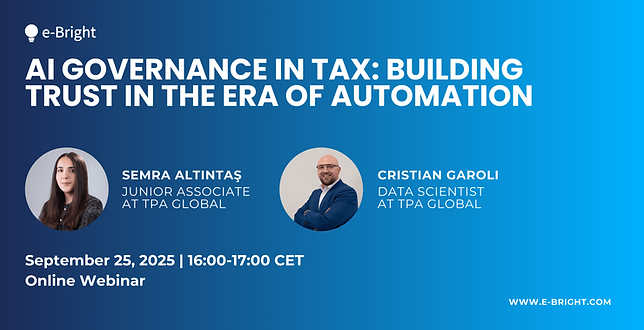
Why Attend
Tax teams are adopting AI at a time when regulatory scrutiny, audit expectations, and assurance requirements are tightening significantly. In 2025, “trust” in tax no longer refers only to professional judgment. It increasingly means demonstrable accuracy, explainability, control, and evidence under evolving EU rules and digital audit standards.
AI introduces new risks alongside its benefits. Hallucinations, data leakage, undocumented model behavior, and unclear ownership can undermine tax positions if governance is not embedded from the start. At the same time, tax authorities are expanding their use of analytics, pre-filling, and real-time data validation, raising expectations for enterprise-level auditability and traceability.
This webinar focuses on AI governance as the foundation for trust in automated and AI-supported tax workflows. It examines how tax teams can move beyond tool adoption and build governance frameworks that align people, processes, and technology. Rather than treating governance as an abstract compliance exercise, the session translates 2025 regulatory guidance into practical operating models.
Attending this session will help participants understand:
Why trust has become the central issue in tax AI adoption
How new EU and OECD expectations affect tax workflows and assurance
How governance enables safe, scalable, and defensible AI use
How to prepare for audits in an AI-enabled tax environment
The session is designed for organizations that want to use AI in tax without sacrificing control, credibility, or accountability.
Topics Covered
The webinar provides a structured view of how AI governance applies across the full tax data and AI lifecycle.
Key topics include:
Why trust in tax AI matters now: Regulatory pressure from the EU AI Act, OECD guidance, and internal audits, combined with business expectations for explainable, evidence-backed tax outcomes.
What tax AI touches: How AI affects workflows, digital artifacts such as datasets and prompts, and the roles of tax teams, IT, auditors, and regulators.
People, process, and technology as the governance backbone: Why AI governance builds on existing tax control frameworks rather than replacing them, with clear roles, documented controls, and secure systems.
From data integrity to legal liability: Why clean, traceable data is the starting point for trustworthy AI, including data contracts, governed pipelines, and a single source of truth.
The AI supply chain: Governance across extraction, transformation, storage, controls, reporting, and digital submission, ensuring compliance and traceability at every step.
Identifying key AI risks: Data risks, model risks, legal and compliance exposure, and people-related risks such as shadow AI and weak maker-checker controls.
Roles and responsibilities in AI systems: How clear ownership across tax, data, IT, and legal functions prevents accountability gaps.
Developing and maintaining an AI protocol: A living operational manual that governs AI use, aligns with EU AI Act and GDPR requirements, and evolves through regular updates.
Assurance and audit readiness: What regulators and external auditors will expect to see in terms of logs, approvals, documentation, and evidence.
The focus throughout is on making governance operational rather than theoretical.
Who Is This For
This webinar is intended for professionals responsible for AI adoption, control, and assurance in tax:
Heads of Tax and Tax Directors: Accountable for defensible tax outcomes in increasingly automated environments.
Tax technology and transformation leaders: Designing AI-enabled workflows that must meet regulatory and audit standards.
In-house tax, finance, and data teams: Working with AI-supported reporting, analytics, and compliance processes.
Risk, compliance, and internal audit professionals: Involved in reviewing and assuring AI-driven tax outputs.
Advisors and consultants: Supporting organizations with AI governance frameworks and audit readiness.
The session is particularly relevant for organizations operating in the EU or under EU-influenced regulatory regimes.