top of page

TAX TECHNOLOGY MAGAZINE

TTMAG is e-Bright’s digital magazine for forward-thinking tax professionals navigating the shift to a data-driven future. Each edition delivers curated insights, expert interviews, and practical guidance on how technology is reshaping the tax landscape.

​

Whether you're leading a transformation project, exploring AI-driven compliance tools, or simply seeking inspiration from peers at the cutting edge of tax and tech, TTMAG brings the future of tax directly to you.

​

Discover thought-provoking perspectives, case-based stories, and the strategies that are helping modern tax teams stay agile, compliant, and ahead of the curve.

TTMAG - Edition 4 

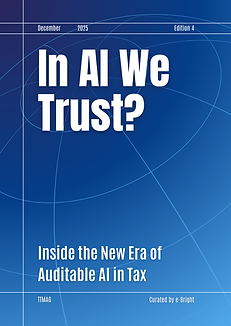
Edition 4 of TTMAG explores what it really means to rely on AI in a field where every decision is regulated, documented, and open to scrutiny. As AI moves from pilots to production, the issue asks under which conditions tax professionals, CFOs and authorities can trust algorithmic systems, and where human judgment must stay firmly in the loop. Through in-depth interviews with academics, heads of tax, technology leaders and founders, this edition looks at governance, data quality, auditability, and the changing skill set of the tax profession in an AI-driven environment.

TTMAG 4.png

Topics Covered

1. Inside the New Era of Auditable AI in Tax
AI in tax has shifted from speculation to consequence, with tools now shaping how data is organized, filings are examined, and risks are managed. It argues that trust in AI rests on two parallel tracks – robust data, processes and controls on one side, and empowered professionals who know how to question and govern AI outputs on the other.

​

2. Two Governance First, Technology Second
In his interview, Prof. Dr. Robert Risse reframes AI as the last step in a much longer journey that starts with people, processes, and data. He explains why tax teams need to translate “taxable sentences” into process logic, how symbolic and sub-symbolic AI can work together, and why standardizing tax law as machine-readable “rules as code” may matter more than standardizing the tools themselves.

​

3. Beyond Automation: Building Trustworthy AI in Tax Compliance
Brigitte Baumgartner Garcia breaks down how large language models really work and why retrieval-augmented and hybrid approaches are essential in highly regulated environments. She highlights governance-by-design, input quality (“garbage in, garbage out”), and hybrid-RAG architectures as practical ways to move from AI that merely answers to AI that reasons in line with tax rules and internal policies.

​

4. From Proof of Concept to Proof of Trust in the Tax Function
Keval Hutheesing looks at what it takes to move from impressive prototypes to AI systems that withstand regulatory and internal scrutiny. He unpacks three pillars of trust – security, accuracy, and compliance – and shows how scoped prompts, curated knowledge bases, detailed logging, and citation-based responses can make AI outputs explainable, traceable, and ready for audit.

​

5. Trust Starts With Data: Foundations for AI in Tax
Anita Richter brings a tax leader’s view on why fragmented systems and unclear ownership are still the biggest barriers to AI. She discusses cloud migration, data governance under the CFO, and the need for closer collaboration between tax and IT, along with the implications of real-time reporting and e-invoicing for both businesses and authorities as AI becomes part of the compliance fabric.

​

6. Reshaping the AI-Augmented Tax Workplace
In the closing interviews, Vishnu Bagri and Lukas Zörner explore how AI is changing roles, responsibilities, and workflows for both large organizations and SMEs. They describe future tax teams where AI agents handle ingestion, reconciliation and first-pass analysis, while certified professionals act as “accountability nodes” who review, sign off, and translate insights into decisions – with human-centered platforms making complex compliance manageable for businesses of every size.

TTMAG - Edition 3 

This edition of TTMAG focuses on what it means to lead in a time of rapid technological change. As tax functions evolve beyond compliance to become strategic partners in the business, leadership is becoming about vision, adaptability, and the ability to guide teams through transformation. This issue explores how tax professionals can build future-ready organizations by embracing real-time data, AI-driven tools, and collaborative ecosystems. From leadership mindsets and upskilling strategies to operational innovation and cross-functional coordination, TTMAG 3.0 offers practical insights for professionals who want to drive the future of tax.

Screenshot 2025-06-27 at 11.06.29.png

Topics Covered

1. What Makes a Digital Leader in Tax

Defines digital leadership in a tax and compliance-driven environment: strategic foresight combined with operational execution. Emphasizes that digital leaders don’t need to be the most technical—they need to understand, translate, and connect expertise across domains. Profiles the mindset and behaviors that enable transformation across tax teams.

​

2. Two Roles Every Tax Department Needs

The magazine outlines the core digital capabilities tax professionals need to develop, including adaptability, strategic technology thinking, and process optimization. It emphasizes mindset over tools: professionals must learn to think digitally before they can act digitally. Examples are given of how digital tools can enhance tax compliance, risk management, and reporting accuracy.

​

3. Understanding the Belt System: Building Competence Step by Step

A deep dive into e-Bright’s Belt System, which serves as a certification pathway for tax technology specialists.

The article maps out how the Yellow, Orange, Light Green, Dark Green and Black Belt levels correspond to different career stages, from entry-level awareness to strategic leadership. Readers learn how this structure supports professional growth in a practical, modular way.

​

4. Voices from the Field: Interviews with Digital Adopters

First-hand stories from professionals who have embraced tax technology. Interviewees share how their roles have evolved, the tools they’ve adopted, and the organizational shifts they've witnessed. Reflections on overcoming resistance to change and aligning tech investments with tax strategy.

​

5. The Case for Certification in Tax Technology

Makes a compelling case for why formal training and certification in tax technology is becoming essential. Discusses the gap between academic education and market needs and how initiatives like e-Bright aim to bridge it. Positions certification not just as a resume boost but as a strategic investment in career longevity.

​

6. Looking Ahead: The Future of the Tax Function

Concludes with a forward-looking view on how AI, automation, and advanced data analytics will redefine the tax landscape. Encourages readers to see themselves as change agents capable of steering tax transformation, not just reacting to it.

TTMAG - Edition 2 

This edition dives into the fast-emerging role of artificial intelligence in the tax domain, with a focus on practical applications and strategic opportunities. It explores how AI is reshaping the day-to-day work of tax professionals, from automating compliance and risk assessments to transforming how tax data is analyzed, interpreted, and presented. With contributions from thought leaders, tech innovators, and hands-on users, the December 2024 issue highlights how professionals can leverage AI responsibly and strategically to stay ahead in a data-driven world.

Screenshot 2025-06-27 at 11.05.52.png

Topics Covered

TTMAG - Edition 1 

1. Understanding AI in the Context of Tax

this edition explores AI through examples, from Keeyns’ NLP summarizers and virtual assistants to DataBoat’s predictive analytics and TaxBright’s smart search. Readers see how real tax teams are applying AI across compliance, reporting, and ESG-linked planning.​

​

2. The TaxBright AI Engine: Inside the Tool

A feature on TaxBright, e-Bright’s AI-powered assistant designed specifically for tax professionals. Detailed explanation of its core functions: source-cited answers, customizable research filters, and smart content suggestions. How it differs from generic AI tools by being trained specifically on tax regulations and expert-reviewed data.

​

3. Human + Machine: Where AI Stops and You Start

Insights from multiple contributors about where human judgment remains essential in an AI-enhanced tax function. Highlights the continuing importance of communication, interpretation, and ethical oversight in tax leadership.

​

4. Emerging Governance and Risks in AI Use

Discussions on software complexity, client resistance, and potential risks with transparency or automation overreach in AI adoption. Practical perspectives from companies navigating change rather than a formal ethics deep-dive.

​

5. Upskilling the Tax Team for a Digital Future

How training, structured onboarding, and tool fluency are preparing professionals for tech-enabled workflows. Emphasis on data literacy, systems thinking, and organizational readiness.

​

6. Interviews with AI Adopters

Insights from professionals who have integrated AI into their tax functions, highlighting both quick wins and long-term challenges. Includes practical tips for onboarding new technologies and managing change across teams.

​

7. The AI Maturity Journey

A visual and conceptual framework showing how a tax department might evolve in its use of AI, from experimentation to full-scale integration. Helps readers benchmark where they stand and plan next steps.

The inaugural edition of TTMAG explores what it means to be a tax professional in a rapidly evolving digital landscape. With a strong focus on artificial intelligence, data governance, and digital transformation, this issue examines how modern tax teams must adapt their workflows, technologies, and mindsets to stay relevant. It features in-depth articles by seasoned experts on managing the complexities of AI adoption, reducing technical debt, and redefining software strategies in tax departments. From interviews with digital leaders to insights into the future of tax compliance, this edition lays the foundation for a forward-looking, tech-enabled approach to taxation.

Screenshot 2025-06-27 at 11.06.12.png

Topics Covered

1. The Modern Tax Professional: A Multidisciplinary Role

This edition introduces the concept of the tax professional as a “fusion profile”, someone who combines expertise in tax, technology, data, and communication. It explains why traditional tax skills are no longer sufficient in a digital-first environment. Key discussion points include the value of coding literacy, data interpretation, and collaboration with IT and finance departments.

​

2. Why Tax Teams Need a Digital Mindset

The magazine outlines the core digital capabilities tax professionals need to develop, including adaptability, strategic technology thinking, and process optimization. It emphasizes mindset over tools: professionals must learn to think digitally before they can act digitally. Examples are given of how digital tools can enhance tax compliance, risk management, and reporting accuracy.

​

3. The Rise of Tax Technology and Technical Debt

This edition provides a deep analysis of how tax technology has evolved over time, highlighting the institutional risks of spreadsheet dependency, the emergence of technical debt, and the need for professionalized software development in tax. Readers gain insight into the real challenges of digital transformation from both strategic and operational angles.

​

4. Voices from the Field: Interviews with Digital Adopters

First-hand stories from professionals who have embraced tax technology. Interviewees share how their roles have evolved, the tools they’ve adopted, and the organizational shifts they've witnessed. Reflections on overcoming resistance to change and aligning tech investments with tax strategy.

​

5. Building the Case for Modernization, Not Just Certification

Discussion on how the tax industry must bridge the gap between outdated educational pathways and modern digital requirements. It positions upskilling, especially in software literacy and system thinking, as a strategic imperative for future tax professionals.

​

6. Looking Ahead: The Future of the Tax Function

Concludes with a forward-looking view on how AI, automation, and advanced data analytics will redefine the tax landscape. Encourages readers to see themselves as change agents capable of steering tax transformation, not just reacting to it.

bottom of page